Showing posts with label sociology. Show all posts

Saturday, December 15, 2012

Human behavior . . .

HUMAN MOTIVATION is incredibly complex. Attempts to tweek with it are invariably mis-directed. Esther Inglis-Arkell's article at io9, "The lasting mystery of the Hawthorne Effect" is worthy of  attention.

The Hawthorne Effect is cited by both business experts and psychology experts, but rarely in the same way. Some say it's real, some that it's real but misinterpreted, and then others that it doesn't exist and never has. It all started with an attempt to increase productivity at a factory in the 1920s, and we've been arguing about it ever since. 

The story of the Hawthorne Effect begins in the 1920s, when productivity studies began at the Hawthorne Works electrical equipment factory in Illinois. They continued for the better part of a decade, with investigators tweaking nearly every aspect of working life.

— The Home Office —

Monday, April 09, 2012

Illusion at sea . . .

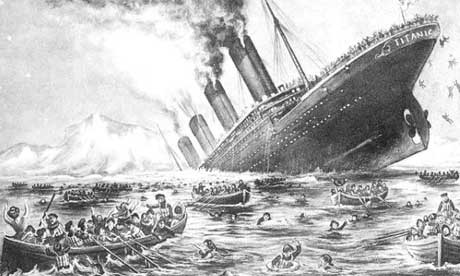
THE TITANIC CENTENNIAL: April 15 marks the hundredth anniversary of the fabled disaster. Part of the history was the "Women and children first!" criteria for lifeboat access. Well, that piqued the interest of  C.O. at THE ECONOMIST, with an article, "Women and children first?".

Survival on board the Titanic is famous for its gender bias: roughly three out of four women survived, and almost half of the children, but only around 20% of men and crew. Social norms, an important building block of an economy, seem to hold up even in the most extreme of circumstances. Or should we say British norms? The recent Costa Concordia disaster off the coast of Italy, in which the captain abandoned his sinking ship, led to discussions of British chivalry at sea.

A new and timely paper from Sweden tries to shed some further light on the issue.  Mikael Elinder and Oscar Erixson of Uppsala University have looked at 18 peace-time shipwrecks for which they could find detailed data. The results are striking. Women had a lower chance of survival in 11 out of 18 instances. Only on two ships was it an advantage to be a woman: on the Birkenhead in 1852 and on the Titanic. The best odds of survival on average were, somewhat surprisingly, those of the crew, followed by none other than the captain. Children were worst off.

Thursday, June 23, 2011

Social stress . . .

THE ROOT is a site devoted to the interests of African-Americans. Jenee Desmond-Harris has an interesting article, "Review: 'Is Marriage for White People?'". You may or may not be aware that black American society has been under tremendous social pressures in recent times, from a myriad of sources, like drugs, discrimination, changing technology and single-parent families.

It's a hell of a problem, and people like Bill Cosby have been calling for attempts to stop this disintegration. There are signs that maybe, just maybe, this has leveled off. But the problem affects different areas of black America in different ways. Consider that small minority of "successful" middle-class black females: finding a mate without the rap and bling and gangsta that has mesmerized black American males.

When titles for this book were being considered, perhaps Why Middle Class Black Women Can't Find a Man and How the Whole Problem Could Be Solved if They Would Just Marry White Guys didn't have quite the ring the publisher was after.

But that's pretty much what Stanford Law professor Ralph Richard Banks' Is Marriage for White People? How the African American Marriage Decline Affects Everyone (in stores this September) is all about.


Is Marriage for White People? will have to answer to some of the same critiques, starting with the initial choice to dramatize the dilemma facing African-American women for whom "unmarried has become the new normal, single the new black," and blaming the "problem" on simple individual choices, instead of a complex set of issues with many causes, effects and stakeholders.

But we can tire of the way the issue is framed without boycotting attempts to get it right. And there are chapters nestled in the middle of the book that should be applauded for accomplishing Banks' stated goal: to tell the stories of single black women and "capture their lives as they experience it."

Wednesday, February 02, 2011

Gender gyre . . .

THE TIMES LITERARY SUPPLEMENT has a fine book review by Carol Tavris, "The new neurosexism", a review of "DELUSIONS OF GENDER", by Cordelia Fine. Apparently, a lot of recent literature on the mental differences between men and women is rather suspect. Tavris points out the book's importance:

Today we look back with amusement at the efforts of nineteenth-century scientists to weigh, cut, split or dissect brains in their pursuit of finding the precise anatomical reason for female inferiority. How much more scientific and unbiased we are today, we think, with our PET scans and fMRIs and sophisticated measurements of hormone levels. Today’s scientists would never commit such a methodological faux pas as failing to have a control group or knowing the sex of the brain they are dissecting – would they? Brain scans don’t lie – do they?

Well, yes, they would and they do. As Cordelia Fine documents in Delusions of Gender, researchers change their focus, technology marches on, but sexism is eternal. Its latest incarnation is what she calls “neurosexism”, sexist bias disguised in the “neuroscientific finery” of claims about neurons, brains, hormones.

“We have been here before, so many times”, writes Fine, with a sigh. No one disputes that the sexes differ physiologically, in hormones and anatomy, or that there are sex differences in the brain related to men’s and women’s different reproductive processes. The eternal question is, and has been, so what? What, if anything, do those differences have to do with work, love, success, ambition, talent, love of sports, and who does the housework? Perhaps they do, says Fine, but “when we follow the trail of contemporary science we discover a surprising number of gaps, assumptions, inconsistencies, poor methodologies, and leaps of faith – as well as more than one echo of the insalubrious past”.