Showing posts with label technology. Show all posts

Friday, September 13, 2013

Comin’ at ya . . .


MIT TECHNOLOGY REVIEW has an article by Aviva Hope Rutkin that you should read and ponder. “Report Suggests Nearly Half of U.S. Jobs Are Vulnerable to Computerization”. 45% is the estimated job loss over the next 20 years.
The authors believe this takeover will happen in two stages. First, computers will start replacing people in especially vulnerable fields like transportation/logistics, production labor, and administrative support. Jobs in services, sales, and construction may also be lost in this first stage. 
What's old is new again.
20 years? Hell, I might even still be alive. As this develops, Conservatives who go berserk at the idea of Food Stamps might want to get therapy. As well, “Liberals”, to use the US term, might want the same. Regardless of where you are on the political spectrum, this is scary: even the crappy jobs will be disappearing as technology develops.

Even if it's only the loss of 25%, not 45% of US jobs, there are going to be a lot of people who are under 40 when this happens who can't work if jobs don't exist, crappy or not, and if they don't starve to death, can expect to live another 30-40 years. Then there's the teenagers and twenty-somethings trying to enter the working world. And if all there is for them are crappy jobs, what will that do for future families?
Wherever he is, Karl Marx is probably laughing hysterically. How will Capitalism cope? As the robotics take over the work force, maybe we might just see a resurgence of “hand-made” items as the items of value.

Tuesday, June 05, 2012

For a future fracas . . .

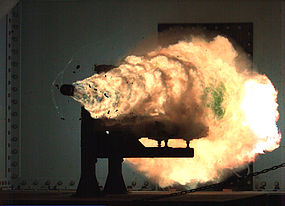
HERE'S THE FIRST LOOK AT THE DDG-1000 ZUMWALT. It's a major part of the USN's answer to the Chinese navy's growth in Asian waters. It's a littoral vessel, designed for coastal patrols. Like everything these days, it's not cheap: according to the Washington Post/Associated Press, "Stealth destroyer, at over $3 billion apiece, is US Navy’s latest answer to rising China"

A super-stealthy warship that could underpin the U.S. navy’s China strategy will be able to sneak up on coastlines virtually undetected and pound targets with electromagnetic “railguns” right out of a sci-fi movie.

But at more than $3 billion a pop, critics say the new DDG-1000 destroyer sucks away funds that could be better used to bolster a thinly stretched conventional fleet. One outspoken admiral in China has scoffed that all it would take to sink the high-tech American ship is an armada of explosive-laden fishing boats.


At 2.4 kilometres per second (5,400 mph), the air burns, no chemical propellant used.
Right now, it's could be, would be, should be, might be. And the Chinese say they are not impressed, but then again, what else are they going to say? HOWEVER, if this is NOT speculative, it may be an indication that the USN has made solid progress with the Polywell Fusion program, which is intended to power those rail-guns. The rail-guns, with a projected 200-mile/320km range, will be appearing later in the decade — if the USN solves the power-source problem.

The DDG-1000 and other stealth destroyers of the Zumwalt class feature a wave-piercing hull that leaves almost no wake, electric drive propulsion and advanced sonar and missiles. They are longer and heavier than existing destroyers — but will have half the crew because of automated systems and appear to be little more than a small fishing boat on enemy radar.

Saturday, September 03, 2011

Stuff . . .

GEORGE CARLIN was very perceptive about our stuff. You know, all the artifacts of life we seem to assiduously acquire.

How all that stuff gets made and distributed has shaped how we live for well over a thousand years. From Greek amphorae of antiquity to the 2-litre pop bottle of today.

TXCHNOLOGIST is an interesting site devoted to technology and science, paid for by one of my less favored corporations, General Electric. With that caveat, I detect no sign of corporate editorializing. And there is a fascinating article, worthy of your attention: "10 Factories That Changed the World". From the Venice Arsenal of 1104, below,

to 2011's Foxconn contract factory, below, very much the descendant of those dark, satanic mills of yesteryear.

Employing 500,000 workers and producing everything from toys to Apple’s iPad, Foxconn’s Shenzhen network of factories has leveraged low labor costs – like many factories around China – and attracted business from the world’s leading multinationals. But if this gargantuan plant symbolizes China’s industrial might, it also symbolizes China’s problems: some 13 workers committed suicide at the Shenzhen plant since 2007, sparking labor unrest and criticism of “hellish conditions” from human rights advocates.

Wednesday, August 24, 2011

Perspective and time . . .

James Burke's The Day The Universe Changed: "The Way We Are". A series worthy of your consideration, as is "Connections". Why? Because change is going to make today seem like a scene from a Jane Austen novel sooner than you might believe.

Friday, February 11, 2011

"Bless Me, Father" - There's an App for That . . . .

But Bennie and his Jerks don't like it.

Via the New York Daily News:

Officials in Rome have declared that an app available on Apple's iPhones, iPads and the iPod touch cannot serve as a confessional.

"One cannot speak in any way of confessing via iPhone," Federico Lombardi, the Vatican's spokesman, said in a statement. "This cannot be substituted by any IT application."


_______________


It also keeps track of your sins and the time between confessions, information it keeps locked away via password protection.


Guess the Vatican figured it wouldn't aid in job security for their flock of shepherds* . . . .


*Numerous other descriptive words came to mind, but I opted to not use them. Feel free to enumerate a few in Comments . . . .

Tuesday, March 24, 2009

Life in the technological fast lane

I haven't owned a car in a decade. Living in Tokyo, I don't really need one. Public transportation and taxis get me everywhere I need to go in the city with a minimum of fuss and expense. Back in Canada, I nearly lived in my car, putting 20-30,000 kilometers a year on the succession of old jalopies I owned. Living out in the countryside or in the suburbs in Canada, a car was an absolute necessity and given the totally inadequate nature of public transit even in the largest cities, having a car even in an urban setting was mighty useful. And expensive ("gas is how much a liter this week?"). And stressful ("traffic is backed up how far?"). And dirty and smelly and noisy and all the other things that go with a gasoline powered vehicle. Traffic in Tokyo is insane and the air is already nearly unbreathable anyways, so as long as I'm here, I don't want a car.
I write about a lot of pretty nasty things on this blog - politics, hypocrisy, war, pestilence, corruption, stupidity and petty meaness and ignorance (and that's just Canadian Prime Minister's office) -- so its really nice to mention something positive for a change.


MDI is a French company that is going to save the world if people give them half a chance. They have created a radical new reimagining of the automobile industry, based on building small local plants that manufacture cars for a local market. Imagine a car built right at the dealership. Their labour-intensive plant design allows for an environmentally-friendly car to be built every half hour at a very, very reasonable cost - meaning lots of steady, decent-paying jobs building non-polluting products where they will be sold. No more having to head to the big city for a factory job. No more stinking industrial hellscapes. No need to ship vehicles thousands of miles to market. Hopefully, their cars will be available in Europe and the US this year.
Oh, and did I mention the cars run on compressed air? No need to waste food crops on biofuels, no need to mess with superflammable hydrogen or propane, no need for gasoline. There is a hybrid model that will run on anything from gasoline to alcohol and give you about 80 km per liter of fuel intended for highway driving, but for city driving, you just hook them up to an air compressor and you can go about 100 km before you need a refill. The bodies are mostly fiberglass, so they never rust. Hook that ordinary air compressor up to a neighbourhood windmill and you might never pay to run your car again. And the basic model sells for between $7000 and $12,000.

They may never replace the gasoline-engine roadster for long-distance highway driving, but think what it would do for air quality if you replaced every taxi, delivery vehicle, commuter car and bus in a city like Tokyo or Los Angeles or Mexico City with something that has zero emissions. Think how much money could be saved in fuel costs. And the loudest thing in them is probably the car stereo.


cross-posted from the Woodshed.

Thursday, January 04, 2007

Close-quarters vibrators?


Think of that vibrating cell phone. The one that causes you to stop in the middle of a crosswalk, dig into your pocket and start talking amongst the crowd. Now, MIT is working on doing the same thing to soldiers and possibly other occupations who need to have information passed to them in a noisy and often confused environments.

A vibrating vest that writes messages on its wearer's back is being tested by researchers in the US. In future, it could be used to send important commands to soldiers or fire-fighters, warning them of imminent danger when ordinary radios cannot be used, for example.

The vest is made from black spandex and fastens around a person's lower torso with Velcro. An array of 16 small vibrating motors is embedded in the back of the vest and connects to a control unit on one side. This unit contains a wireless transceiver linked wirelessly to a controlling computer.

Hmmm... sounds like a good idea on the surface except that it is yet another item for the poor infanteer to strap on before going to work. The other thing is that it's jammable as is any radio signal.

Commands sent from the computer are translated into patterns "displayed" – like Braille-on-the-back – by the vibrating motors. The wearer's back was chosen to receive messages because it is a relatively large area that is also less likely to sustain damage.
The US army is part-funding the research: "They are interested in a way to communicate simple commands in situations when the hands are doing other things, or radios can't be used," explains Lynette Jones, the MIT engineer leading the project.
OK. I wonder is Lynette aware of this program? The Land Warrior program integrates several systems onto the body of a dismounted (moves on foot) soldier. One of them is a communications system. A problem with both the "soldier" and the "leader" radio is that the effective range is about 1300 meters. More range would certainly help, but if the soldier is being sent maneouvring signals does that not mean he/she is within visual range?

Right now the US soldier using a Land Warrior system carries 92.5 lbs. of gear (including weapon) into close combat. That is expected to be reduced to 84 lbs. That's one helluva combat load.

Eight of the symbols are derived from hand signals already used by the US military. "They communicate things like stop, look left, run, proceed faster or proceed slower," explains Jones. When four corners of the array vibrate, for example, this means stop. And a vibrating column, moving from one side to the other, means turn left or right.
This system looks to be one-way or "simplex". The current Land Warrior system offers two way communications, a global positioning system, a computer and monocle viewer.

There is also the question of vibrating motors under a load carrying harness... ouch!

Although... a little soothing back massage in the middle of a close-quarters battle would actually be kind of... you know... exciting relaxing.
(I told you this was coming)