Showing posts with label warfare. Show all posts

Tuesday, June 05, 2012

For a future fracas . . .

HERE'S THE FIRST LOOK AT THE DDG-1000 ZUMWALT. It's a major part of the USN's answer to the Chinese navy's growth in Asian waters. It's a littoral vessel, designed for coastal patrols. Like everything these days, it's not cheap: according to the Washington Post/Associated Press, "Stealth destroyer, at over $3 billion apiece, is US Navy’s latest answer to rising China"

A super-stealthy warship that could underpin the U.S. navy’s China strategy will be able to sneak up on coastlines virtually undetected and pound targets with electromagnetic “railguns” right out of a sci-fi movie.

But at more than $3 billion a pop, critics say the new DDG-1000 destroyer sucks away funds that could be better used to bolster a thinly stretched conventional fleet. One outspoken admiral in China has scoffed that all it would take to sink the high-tech American ship is an armada of explosive-laden fishing boats.
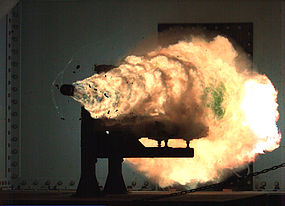

At 2.4 kilometres per second (5,400 mph), the air burns, no chemical propellant used.
Right now, it's could be, would be, should be, might be. And the Chinese say they are not impressed, but then again, what else are they going to say? HOWEVER, if this is NOT speculative, it may be an indication that the USN has made solid progress with the Polywell Fusion program, which is intended to power those rail-guns. The rail-guns, with a projected 200-mile/320km range, will be appearing later in the decade — if the USN solves the power-source problem.

The DDG-1000 and other stealth destroyers of the Zumwalt class feature a wave-piercing hull that leaves almost no wake, electric drive propulsion and advanced sonar and missiles. They are longer and heavier than existing destroyers — but will have half the crew because of automated systems and appear to be little more than a small fishing boat on enemy radar.

Saturday, February 14, 2009

The Paradox of Military Technology


THE NEW ATLANTIS SITE has a very interesting piece, The Paradox of Military Technology, by Max Boot, that looks at today's military milieu.
“With the possible exceptions of night-vision devices, Global Positioning Systems, and shoulder-fired missiles,” writes retired Major General Robert Scales, a former commander of the Army War College, “there is no appreciable technological advantage for an American infantryman when fighting the close battle against even the poorest, most primitive enemy.”
That's the Kalshnikov Scourge, folks. Going great guns in the Congo, these days.
"Information technology is central to American military dominance. Not all of the changes wrought by the information age are obvious at first glance, because the basic military systems of the early twenty-first century look roughly similar to their predecessors of the second industrial age—tanks, planes, aircraft carriers, missiles. "
That's IT and digital electronics data links and phased array radar and gun computer systems.

It may be the RFID that may be of future consideration:
The most important challenge for the U.S. armed forces and their allies in the post-9/11 world is to “leverage” their advantage in conventional weaponry to deal with today’s unconventional threats. Information technology can be an important part of this task. Embedded microchips can track the 18 million cargo containers moving around the world and help prevent terrorists from using them to smuggle weapons.

As well, P. W. Singer has an interesting take on robotics, with Military Robots and the Laws of War :
When U.S. forces went into Iraq, the original invasion had no robotic systems on the ground. By the end of 2004, there were 150 robots on the ground in Iraq; a year later there were 2,400; by the end of 2008, there were about 12,000 robots of nearly two dozen varieties operating on the ground in Iraq. As one retired Army officer put it, the “Army of the Grand Robotic” is taking shape.