Showing posts with label history. Show all posts

Monday, May 20, 2013

Pox perspective . . .

OUR WELTANSCHAUUNG: how much of it has been shaped because somebody creative had a dose? You know, the gift-that-keeps-on-giving, aka syphilis, aka "The French Disease"?  Creative types, like Schubert, Schumann, Baudelaire, Maupassant, Flaubert, Van Gogh, Nietzsche, Wilde and Joyce and their crotch critters?

Sarah Dunant, at The Guardian, has a fascinating look at the historical effects of 'The Pox', with an article, "Syphilis, sex and fear: How the French disease conquered the world" that is worthy of your attention. You sure did not want to live before the discovery of antibiotics, syph is a nasty way to die.  As pay-back for Smallpox, this New World invader cut a hell of a swath through Europe, you just took years to die and enjoy the process.

Historians mining the archives of prisons, hospitals and asylums now estimate that a fifth of the population might have been infected at any one time. London hospitals during the 18th century treated barely a fraction of the poor, and on discharge sufferers were publicly whipped to ram home the moral lesson.

The Critter: Treponema pallidum
on cultures of cotton-tail rabbit epithelium cells
Again, until the discovery of antibiotics, there was no cure. What's old, is new again:

Much of the extraordinary detail we now have about syphilis is a result of the Aids crisis. Just when we thought antibiotics, the pill and more liberal attitudes had taken the danger and shame out of sexual behaviour, the arrival out of nowhere of an incurable, fatal, highly contagious sexual disease challenged medical science, triggered a public-health crisis and re-awoke a moral panic.

Not surprisingly, it also made the history of syphilis extremely relevant again. The timing was powerful in another way too, as by the 1980s history itself was refocusing; from the long march of the political and the powerful, to the more intimate cultural stories of everyman/woman.

Sunday, April 14, 2013

Fifty years ago . . .

— KIM & LEE —
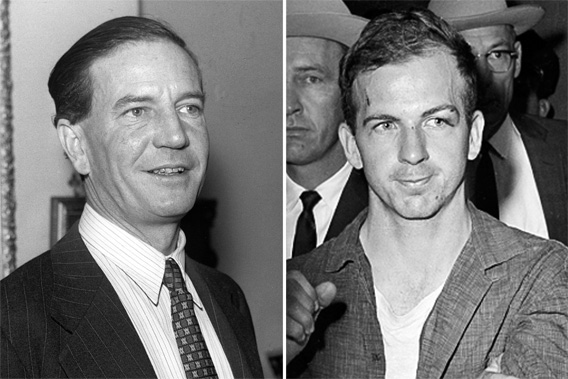
1963, LEE HARVEY Oswald is murdered and Kim Philby defects — two individuals who effected great changes. Or not; nobody seems to know for sure, in both cases.  

Ron Rosenbaum has a great article in SLATE, "Philby and Oswald The truth is still out there." Maybe there are things are still to be discovered.

Sunday, July 15, 2012

Historical perspective . . .

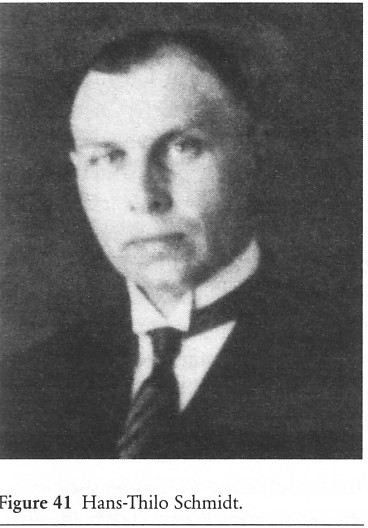
80 YEARS AGO, HANS THILO-SCHMIDT needed money to keep his love-nest going. Seeing as Hans was working at the German Armed Forces' cryptographic headquarters, the Cipher Office, he had some secrets to sell. The German army and navy had adopted an improved Enigma cipher machine after the revelation that the US and the British had broken German codes in WW1.

So in 1932, Hans approached the French, and Captain Gustave Bertrand of French Intelligence seized the opportunity — to no avail, initially. The French looked at the Enigma manual and daily code key, and pronounced it unsolvable, as did the English. Things might have died right there, but Capt. Bertrand approached the Polish secret service's cipher office, who eagerly accepted the gift.
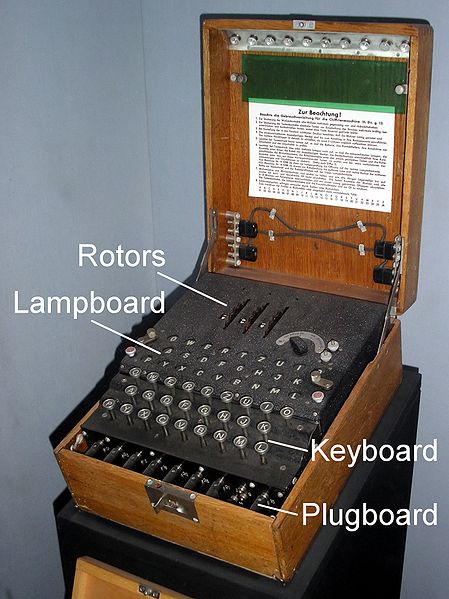
He furnished Gustave Bertrand of the French Intelligence service a booklet detailing the Enigma machine setup procedures. There was no mention of the rotor wiring or information on the keys. In fact, it was more than a booklet but seven documents with two important ones: User Manual for Enigma and Enciphering Procedure for Enigma with drawings and pictures . The French puzzled over this information, then consulted with the British, who agreed that it was insufficient to be of any practical use. No one knows why the this valuable information was rejected. Bertrand then offered it to Lt Col Langer, head of the cipher office in Poland who was overjoyed upon receiving even this small crumb. Rejewski (one of the three mathematics experts) asked Bertrand if he could obtain some outdated Enigma keys. The Frenchman relayed this request to Schmidt who readily obliged, and the keys were passed back to Poland.

With keys given them by the French, and using replica machines they had built, the Polish team of
Marian Rejewski, Jerzy Rózycki and Henryk Zygalski were able to decode most German messages.

And then the Germans introduced an expanded Enigma rotor set, just before the outbreak of WW2. Adding 2 more rotors to the 3 already used, plus the addition of the plugboard meant that the solution of these new Enigma ciphers got vastly bigger, too big for the Poles to tackle. The Poles could see war approaching, so they passed their latest findings over to the British as Warsaw got pounded.

This time, the British got with the program, Bletchley Park came to be, and the Americans got up to speed with the new electro-mechanical tabulating machines, with National Cash Register supplying the machines that broke the most stubborn of all Enigma traffic, the German Kriegsmarine.  This left Bletchley to tackle other Nazi ciphers, including the Offizier cipher and the Lorenz cipher in which Hitler corresponded with his generals.

Out of this effort, Alan Turing invented the first programmable electronic computer, Colossus. From these beginnings, a new digital world appeared.
Colossus Mk 2

So, from the wellspring of venality and greed, the source of change. Historians have said that the Ultra effort shortened the war by two years, maybe more. Certainly the Enigma decrypts resulted in the defeat of the U-boat campaign, with the withdrawal of the wolfpacks by mid 1943.

But Ultra actually accomplished more than the mainstream historians would suggest. IMHO, without Ultra, the chances are very good that Russia would have collapsed in 1942-1943. Why? Because Stalin had purged the Red Army officer corps and the NKVD, and the survivors were easy pickings for the German veterans.

But the British did not share any details about Ultra with the Russians, except to give general warnings. It was the efforts of the Cambridge Five that got the decrypts to Moscow Center.  Kim Philby (cryptonym: Stanley), Donald Duart Maclean (cryptonym: Homer), Guy Burgess (cryptonym: Hicks) and Anthony Blunt (cryptonym: Johnson) and John Cairncross (cryptonym: Liszt) were ideological spies, who believed that Socialism was the future, in spite of Stalin. Their efforts, as recounted by one of their major "handlers", Yuri Modin, in his book, "My Five Cambridge Friends" were tireless in their efforts to pass along the Bletchley decrypts.

From their efforts, the Russians had the Wehrmacht "order of battle", the disposition and organization of Wehrmacht units, as well as Luftwaffe disposition. This last was extremely critical, as the Soviet air power was able to destroy a lot of Luftwaffe aircraft before the battle of Kursk, and the Luftwaffe was never able to catch up.

Without the chain of events unfolding as they did, the chances were very good that Russia could have collapsed, the US and the UK would have had to agree to an armistice with Nazi Germany that might have survived in some fashion until the US could have started irradiating German cities with A-bombs in 1946.

From chaos, venality and patriotism, we get to today. Everything has changed, and nothing has changed: we have Wikileaks, Bradley Manning and OWS, Occupy Wall Street.

It may be delusional, but I like to believe that more and more people are taking their freedom more seriously. Today's fascists have eschewed the funky Nazi uniforms for Armani suits, Rolexes and Porsche Designer Sunglasses, but like the fascists of old, the ruthlessness remains — only this time the ruthlessness is hidden in the smoke and mirrors of "patriotism". Meanwhile, the true patriots, the Bradley Mannings of this world keep appearing, to try to make things right and the eternal battle against fascism continues.


Wednesday, February 29, 2012

On this day in 1982

Well, really, there wasn't one. 1982 was not a leap year. So, in 1982, looking back at the events of the last Saturday and Sunday of that February, it was actually Monday, March 1st.

On the preceding evening Margaret Thatcher stood outside number 10 Downing Street and waxed poetic about how, "We handled it superbly." That would be a "royal" we. She was referring to the outcome of a hijacked aircraft sitting in the middle of Stansted airport which saw passengers and crew released and the hijackers taken into custody after a relatively long set of negotiations. The aircraft was never stormed by the waiting SAS unit and Thatcher, while she gave credit to the police, couldn't resist giving her Home Secretary a nice firm stroking.
First it was handled right by the police in the field and then by Willie Whitelaw at the centre.
... were her words. She had been at the Royal College of Music that night and Willie Whitelaw to whom she referred had become notorious for his largely ineffectual "law and order" agenda which, along with a prison-building effort, included a regurgitation of the 1824 Sus Law which allowed police to stop, search and arrest anyone they thought suspicious for any reason.

The 28th of February 1982 had seen some activity in New York. The Puerto Rican nationalist group Fuerzas Armadas de Liberación Nacional bombed Wall Street. Not that such bothered anyone in the UK much. Since Thatcher had gone all crunchy on Northern Ireland bombings by the IRA Provos had become epidemic in England. 


The other thing that had happened in New York over the weekend was a meeting between British and Argentinian representatives in an effort to sort out the differences that existed over the sovereignty of the Falkland Islands. Thatcher had something to say about them too. Productive and cordial was her description. We were all well aware that the Argentinians didn't see it that way. 


Heading into March we were aware of other things. HMS Invincible, one of three anti-submarine warfare aircraft carriers, was about to be sold to the Australians. And we had just heard that the Antarctic patrol ship, HMS Endurance, was to be permanently withdrawn from the south Atlantic at the end of her deployment. 


Thatcher, now profoundly unpopular in Britain, had embarked on a "thinning" of the armed services which were to add redundant service personnel to the burgeoning ranks of the unemployed. In fact, she was about to rip the guts out of the British forces in being despite her continuing rhetoric demanding that Britain be viewed as a world military power. 


What we now know, thanks to the expiry of the 30 year rule prohibiting publishing internal British government documents, is that Thatcher was intent on dismantling the Royal Navy and was locked in a heated fight with then-First Sea Lord, Sir Henry Leach. If you were there at the time you had a fairly good understanding that things were not well between the RN and Thatcher, but Leach, in keeping with solid RN tradition, uttered not a word outside his office. 


Not so a young colour sergeant who was having a heated exchange with an armourer back in garrision. The week before had seen him and his men spending more time clearing stoppages on weapons than putting ordnance on targets. He was complaining that if he had to use them to actually fight, a lot of people other than the enemy would be getting killed. 


The armourer was sympathetic but tried to quell the NCO's fears by suggesting that nobody was going to war anytime soon. He would take a look at the weapons. 


The NCO replied with, "You know, mate, with Mugsy (Thatcher) on her belly the way she is, the only way out for her is to get us into a shooting match. It wouldn't surprise me if I'm somewhere in the Middle East aiming at Arabs by the start of Summer."


He had the enemy and the location wrong. 


Sunday, June 12, 2011

The perspective of stuff . . .

PEOPLE WHO MAKE HISTORY do so by living, and to do that, they need stuff. What that stuff is, who has it and how much of it they have, can tell historians a lot about the process of change over time.

Fernand Braudel was one of the first to appreciate the importance of the apparently inconsequential components = stuff = of everyday life, in his seminal tome, "Capitalism and Material Life, 1400–1800", a broad-scale history of the preindustrial modern world.

The Boston Globe has a fascinating account of progress in the examination of all these lists of stuff, by Gal Beckerman, "Empty trash. Buy milk. Forge history."

What has emerged so far is not just a glimpse of German life over three centuries, but also confirmation of a theory of Europe’s economic development. The team has already gone through 28,000 handwritten folios, representing 460,000 separate items of property and their monetary values, and by providing this sort of granular detail into what people owned from 1600 to 1900, Ogilvie has been able to track the beginning of consumerism. When did women start buying butter and beer at the market, instead of churning or brewing at home? When does the first nutmeg grater or coffee cup appear, indicating the arrival of exotic goods? Or for that matter, when do villagers start wearing an imported cotton fabric like calico? These small indicators lend support to a new understanding of the period before the Industrial Revolution, when historians like Ogilvie posit that there was an “Industrious Revolution,” increased consumption of luxury items that led to a desire for more income, changing people’s working habits and spurring the creation of faster, more efficient production models.

Saturday, February 05, 2011

Hidden charms . . .

HAVE YOU EVER READ "The Works of the Earls of Rochester and Roscommon"? Me neither. It's an obscure volume of poetry from the 18th century — that was in-print continuously for a century. The secret of its, um, staying power, came to light with the discovery by Oxford University researcher, Dr Claudine van Hensbergen, of a series of erotic poems hidden in the back of the book.

Dr van Hensbergen said: ‘I had just finished entering details of poems typical of miscellanies of the period- satires, imitations and amatory verse, when at the end of the second volume a new title page announced the start of ‘The Cabinet of Love’.

‘To my surprise, ‘The Cabinet’ turned out to be a collection of pornographic verse about dildos. The poems include ‘Dildoides’, a poem attributed to Samuel Butler about the public burning of French-imported dildos, ‘The Delights of Venus’, a poem in which a married woman gives her younger friend an explicit account of the joys of sex, and ‘The Discovery’, a poem about a man watching a woman in bed while hiding under a table.

‘In later years, a celebratory poem about condoms was added, as well as several obscene botanically themed verses attributed to ‘a Member of a Society of Gardeners’ in which male genitalia is described as the ‘tree of life’.’

Tuesday, January 26, 2010

A mystery

IO9 has a fascinating report by Ed Grabianowski, on the latest discoveries concerning a mystery device, called the Antikythera mechanism:

X-rays and advanced photography have uncovered the true complexity of the mysterious Antikythera mechanism, a device so astonishing that its discovery is like finding a functional Buick in medieval Europe.

Using nothing but an ingenious system of gears, the mechanism could be used to predict the month, day and hour of an eclipse, and even accounted for leap years. It could also predict the positions of the sun and moon against the zodiac, and has a gear train that turns a black and white stone to show the moon's phase on a given date. It is possible that it could also show the astronomical positions of the planets known to the ancients: Mercury, Venus, Mars, Jupiter and Saturn.


The Antikythera mechanism wasn't just a scientific tool – it also had a social purpose. The Greeks held major athletic competitions (such as the Olympics) every two or four years. A small dial within the Metonic dial showed the dates of these important events.

Tuesday, March 03, 2009

Named after a steamroller...

On March 4th, 1966, (some will say April, but that was their debut), Stephen Stills, Dewey Martin, Bruce Palmer, Rich Furay and Neil Young formalized the formation of a new folk-rock music group.

Stills and Furay were staying with record producer Barry Friedman. Parked outside Friedman's house was a steam-roller embossed with the name of the manufacturer - Buffalo-Springfield Roller Company.

This was their first release:


OK, ok. They went on to produce this:

Sunday, February 10, 2008

I wanna hold your hand

It's Sunday night. Television is a reality in most North American homes. At 8 p.m. most of the television viewers from the Rio Grand to Cold Lake have "warmed up" the set to watch Ed Sullivan.

On a Sunday night, on the Ed Sullivan Show, 44 years ago tonight, this happened.


And our parents watched our reaction in horror.

Hat tip to Clarkspick.com... who's terrific music site is being added to the blogroll.

Tuesday, February 05, 2008

Would you like to ask the same question here?


Britons, it appears, are letting their own history slip through their fingers. Or go in one ear and out the other.
23 per cent of respondents to a recent survey thought Winston Churchill was a fictional character while 58 per cent thought Sherlock Holmes had been a real person.

The survey, commissioned by British cable channel UKTV Gold, polled 3,000 adults and came up with some surprising results on the nation's perception of its past.

Forty-seven per cent of Britons thought the 12th-century Crusader king, Richard the Lionheart, was a mythical figure – exactly the same percentage who thought Eleanor Rigby of the eponymous Beatles song was a flesh-and-blood person.

The study noted a marked change in how people acquire their historical knowledge. Fully 77 per cent admitted to no longer reading history books. Three out of five people said they never watched historical programs on television and 15 per cent said they rely solely on the history they learned at school.

Which meant a lot of them weren't paying attention when they were being taught about the Crimean War, because 23 per cent thought nursing pioneer Florence Nightingale was a figment of some writer's imagination. And in an odd twist, 3 per cent thought one of Britain's greatest writers of fiction – Charles Dickens – was fictional himself.

Jeebus. British TV must have gotten a whole lot better than it used to be if people aren't watching the historical programs. That, or a whole lot worse.

Asking those same questions in North America might produce some surprizing results too. Of course, we would have to include a harp-playing chicken, living in a bag in a castle in any such survey.