Showing posts with label consumerism. Show all posts
Monday, January 16, 2012
Consumerism . . .
Labels:
consumerism,
electronics
Wednesday, December 28, 2011
How much crap do you need?
CONSUMERISM. You look at the Boxing Day ads, ya gotta wonder, doesn't everybody have a flat-screen
TV? Like the song goes, buy, buy . . .
Labels:
consumerism
Sunday, November 29, 2009
A Blue Black Friday . . . .
I don't want to be Scrooge here (well, maybe I do) but personally, I think this is a positive development. People just don't need all the crap they buy!
Per Reuters this afternoon:
Shoppers spent less over Black Friday weekend
Sun Nov 29, 2009 4:53pm EST | By Nicole Maestri
SAN FRANCISCO (Reuters) - Consumers spent significantly less at the start of the holiday season this weekend, dimming hopes for a retail comebackthat would help propel the economy early in 2010.
While shoppers turned out in force as early as Thanksgiving Day on Thursday, many said they had zeroed in on highly discounted items, would buy only what they needed and would walk out of a store if they did not find a good deal.
_______________
Consumers said they will have spent nearly 8 percent less on average, or about $343 per person, over the weekend that includes Thanksgiving, Black Friday and runs through Sunday, according to the NRF.
_______________
Shoppers interviewed across the country by Reuters over the weekend said they were lured by bargains, but would stick to pared-down budgets.
"If they don't have rebates and sales before Christmas, I don't think people are going to go back shopping after Black Friday," said Joel Wincowski, a higher education consultant shopping at a Best Buy store in Plattsburgh, New York. He bought an Xbox 360 game console for $299.
"We're going to cut back on everybody, even the kids."
As "drf" has advocated for years:
"Simplify your life" . . . .
(Cross-posted from Moved to Vancouver)
Labels:
consumerism
Thursday, November 19, 2009
Agora Agony
Last Rites: Even with God's help, this shopping center in Pahrump, Nevada, probably cannot be revived.THE DESIGN OBSERVER is one of the more thoughtful web sites dedicated to the appreciation of design of all kinds. Mark Dery has an article, titled "Dawn of the Dead Mall", where he proclaims "The landscape is littered with the giant carcasses of failed retail emporia. Ideas for what's next are no less visionary. But are they any more practical?"
The multitiered, fully enclosed mall (as opposed to the strip mall) has been the Vatican of shiny, happy consumerism since it staked its claim on the crabgrass frontier — and the public mind — in postwar America. The nation’s first enclosed shopping mall, the Southdale Center, opened its doors in Edina, outside Minneapolis, in 1956. Southdale was the brainchild of the Los Angeles– based architect (and Viennese refugee from the Anschluss) Victor Gruen. A socialist and former student of the modernist designer Peter Behrens, Gruen saw in the covered mall a Vision of Things to Come.
But it wasn’t Gruen’s Mad Men take on the Viennese plazas he remembered so fondly that made his Ur-mall go viral. Developers liked the way Gruen used architecture to socially engineer our patterns of consumption. His goal, he said, was to design an environment in which “shoppers will be so bedazzled by a store’s surroundings that they will be drawn — unconsciously, continually — to shop.” (Remember, Gruen was from Freud’s Vienna, where psychoanalysis was a growth industry.)
Unfortunately, Gruen made the fatal mistake — fatal for an arm-waving futurist visionary, anyway — of living long enough to see American consumer culture embrace his idea with a vengeance. In a 1978 speech, he recalled visiting one of his old malls, where he swooned in horror at “the ugliness...of the land-wasting seas of parking” around it, and the soul-killing sprawl beyond.
Good thing he didn’t survive to see the undeath of the American mall. Most economic commentators attribute its dire state to the epic fail of the American economy. In April of this year, one of the country’s biggest mall operators — General Growth Properties, owner and/or manager of over 200 properties in 44 states — filed for bankruptcy, mortally wounded by the exodus of retail tenants.
Anyway, Mark has lots to say. Along the way, check out DEAD MALLS.COM, an eponymous web site with interesting stuff, including a Dead Mall Dictionary, with situationally-relevant entries like
Labelscar: Fading or dirt left behind from a sign on or in a mall. Labelscars leave a readable marking, which is very helpful when identifying former stores.
It is also interesting to see how Europeans look upon the situation. DER SPIEGEL has a great piece with some neat photos, like the one at the top. Originally published in German, you sure have to love that Google Translation.
The multitiered, fully enclosed mall (as opposed to the strip mall) has been the Vatican of shiny, happy consumerism since it staked its claim on the crabgrass frontier — and the public mind — in postwar America. The nation’s first enclosed shopping mall, the Southdale Center, opened its doors in Edina, outside Minneapolis, in 1956. Southdale was the brainchild of the Los Angeles– based architect (and Viennese refugee from the Anschluss) Victor Gruen. A socialist and former student of the modernist designer Peter Behrens, Gruen saw in the covered mall a Vision of Things to Come.
But it wasn’t Gruen’s Mad Men take on the Viennese plazas he remembered so fondly that made his Ur-mall go viral. Developers liked the way Gruen used architecture to socially engineer our patterns of consumption. His goal, he said, was to design an environment in which “shoppers will be so bedazzled by a store’s surroundings that they will be drawn — unconsciously, continually — to shop.” (Remember, Gruen was from Freud’s Vienna, where psychoanalysis was a growth industry.)
Unfortunately, Gruen made the fatal mistake — fatal for an arm-waving futurist visionary, anyway — of living long enough to see American consumer culture embrace his idea with a vengeance. In a 1978 speech, he recalled visiting one of his old malls, where he swooned in horror at “the ugliness...of the land-wasting seas of parking” around it, and the soul-killing sprawl beyond.
Good thing he didn’t survive to see the undeath of the American mall. Most economic commentators attribute its dire state to the epic fail of the American economy. In April of this year, one of the country’s biggest mall operators — General Growth Properties, owner and/or manager of over 200 properties in 44 states — filed for bankruptcy, mortally wounded by the exodus of retail tenants.
Anyway, Mark has lots to say. Along the way, check out DEAD MALLS.COM, an eponymous web site with interesting stuff, including a Dead Mall Dictionary, with situationally-relevant entries like
Labelscar: Fading or dirt left behind from a sign on or in a mall. Labelscars leave a readable marking, which is very helpful when identifying former stores.
It is also interesting to see how Europeans look upon the situation. DER SPIEGEL has a great piece with some neat photos, like the one at the top. Originally published in German, you sure have to love that Google Translation.
Labels:
bankruptcy,
consumerism
Monday, August 06, 2007
I must have that.

While reading The Mess That Greenspan Made (that's the name of the blog), I came across this interesting little bit:
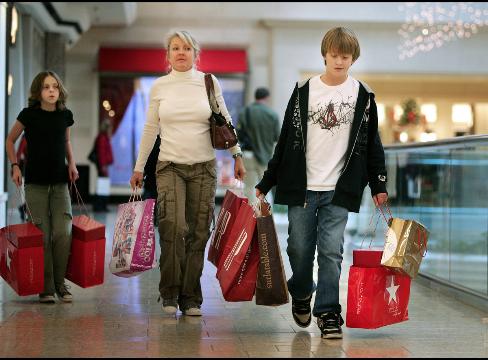
Before Claire Stern goes back to school as a high school senior this fall, she needs a new tote. But not just any bag will do. "I want a tote bag by Jaye Hersh that the celebrities are wearing, they're called Market Bags," said Stern, 17, who lives in Bronxville, New York. "It's more stylish than a backpack." The bags retail for more than $100 if they're monogrammed and Stern has noticed actresses Reese Witherspoon and Jessica Alba wearing them. Shopping for back-to-school apparel is a late summer ritual. But as tweens and teens become increasingly savvy about fashion, they're asking for luxury products, such as $200 designer handbags and $100-plus jeans.Is there anything of a familiar ring with some of the parents of teens out there?
Meanwhile, the luxury market is booming. Sales worldwide topped $150 billion last year. Teens are playing an increasing part in that, according to experts, as Web sites, tabloids and TV shows detailing celebrities and fashion make kids more aware of and demanding for luxury goods than ever before. "They're prime candidates for luxury," said Gerald Celente, publisher of Trends Journal, a newsletter that tracks a wide range of trends. "Their world is the entertainment world and that's what they're focused into."Sick yet?
[...] Amy Klaris, a branding specialist at consulting firm Kurt Salmon Associates, said over the past year or two years, having a luxury item has become more important to teens. "There are so many icons out there right now for them," Klaris said. "There's more people they're looking up to and wanting to emulate, and they can do that through accessories." Where parents put their foot down depends on their income, said Klaris. And while a wardrobe of Prada might be too much for a parent to handle, they might be more willing to spend on accessories, she said. "They want their kids to fit in," she said. "They're still buying T-shirts at Target, but still having that (luxury) handbag."
Jeans - the premium denim that has been popular for several years and costs between $100 and $300- are another popular choice. "Having the coolest label of denim is something that every girl desires," Nasser said. "J Brand, Acne, Earnest Sewn, True Religion, Ksubi are all brands that will be big this year."I just thought I'd help you out with the brand names there. You know, so when you hear, "Like, they're just awesome! It's only one pair! I have to have a pair of Acne!" (I'm making myself sick.)
Celente, publisher of Trends Journal, said that while teens might not have full time jobs, they don't have many expenses either, so they spend all their money on themselves. Youth research company Teenage Research Unlimited, said teenagers between 12 and 19 years old spent $179 billion in 2006, or $102 per teen per week. "(Teens) don't have mortgages to pay and they don't have rent," Celente said. "They have disposable income." Stern, who has saved up her own money to buy $200 Tory Burch shoes and thinks $125 Ray Ban sunglasses will be popular this year, agreed. "Since I'm in high school and not really concerned about rent money, if I want to buy stuff for me, with money I earn, its going to be something to do with fashion," she said.Who did she learn this from? Look around the house. The gremlin that creates these kids is close by. Some parents put their foot down.
Stern added there is a limit to her back to school spending. Her parents would draw the line, for example, at an iPhone, which retails for about $600 - the total amount Stern predicts she'll spend on back-to-school shopping. "Although it is cool and new, it is too much money and there are a few flaws in it," she said. "I understand why my parents wouldn't pay for it."Why... that's so adult of her. She'll accept doing without an iPhone because her parents won't pay for it.
I can only repeat the point that Tim made:
Methinks the younger generation has a somewhat distorted perception of money after watching their parents gorge on home improvements, vacations, recreational gear, and second homes over the last five years.The Mess That Greenspan Made is great reading. And if you've just recently heard the US housing bubble and "easy" mortgage market recently described as a Ponzi scheme, you'd be interested to know that Tim called it that exactly two years ago.
Remember that these are the same teenagers who are going to be in the labor force paying ... taxes to fund the baby boomers' retirement over the next forty years.
I wonder how that's going to work out.
Labels:
consumerism,
teens
Subscribe to:
Posts (Atom)