There had been an explosion of technology in the world of the merchant marine. Marconi radio stations, having been established on both sides of the Atlantic in 1902, were now standard equipment in ships at sea. It meant ships, which for centuries had sailed the worlds oceans in complete isolation, could maintain contact with their flag countries and, perhaps significantly, each other.
Jack Phillips was a Chief Radio Officer. Harold Bride was his deputy. Both were sea-going telegraphists for the Marconi Wireless Corporation. Their assignment was callsign MGY, the White Star Liner, RMS Titanic. On the morning of April 15th, 1912, Phillips was 25 years old; Bride was 21.
------
At 15 minutes past midnight, local time, 100 years ago, the silence of the ether was shattered as the radio officers in the steam ships La Provence, Frankfurt, Mount
Temple and the radio station at Cape Race, Newfoundland heard this:
Two hours and two minutes later, with water rushing into Titanic's wheelhouse, and well after the master, Captain Smith, had released them to abandon ship, the weak signals from callsign MGY, sent by Phillips and Bride, went silent.
The world changed right then.
------
Titanic, the ship, was the crowning achievement of that era's shipbuilding technology. Simply put, no other merchant ship of the day could match its survivability. It was described as a giant lifeboat. It was designed to withstand broadside collisions and head on impact. The compartment structure ensured reserve buoyancy.
Until it didn't.
Titanic, the idea, was the product of a poorly regulated British merchant marine and a belief that the leaders of the shipping world would only damage their own marketability if they did not develop safer ships. Titanic, (and her sister Olympic), were built to advance trans-Atlantic travel and make it safer. Much safer. Prior to the advancements incorporated in the White Star Lines ships, sinkings in the Atlantic were all too common.
Titanic, the idea, was a costly testament to the belief that shipowners would not jeopardize their continued business by building an unsafe vessel and employing untrained crew. It was the result of leaving the science of ship construction wholly in the hands of the operators. They missed more than they caught. 1,517 people paid the price.
------
Chief radio officer Phillips and 2nd Radio Officer Bride departed the radio office as the water overtook them. They had stayed at their posts to the end. Phillips went aft and his body was never found. Bride went to the unlikely collapsible lifeboat B, which was not hung in a davit. He survived until his death by natural causes in 1956.

A tail dragging romp through the swamps of the world
Showing posts with label Titanic. Show all posts
Showing posts with label Titanic. Show all posts
Saturday, April 14, 2012


Monday, April 09, 2012
Illusion at sea . . .
THE TITANIC CENTENNIAL: April 15 marks the hundredth anniversary of the fabled disaster. Part of the history was the "Women and children first!" criteria for lifeboat access. Well, that piqued the interest of C.O. at THE ECONOMIST, with an article, "Women and children first?".
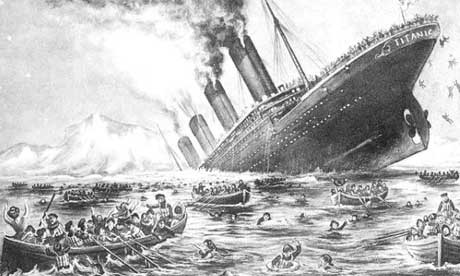
Survival on board the Titanic is famous for its gender bias: roughly three out of four women survived, and almost half of the children, but only around 20% of men and crew. Social norms, an important building block of an economy, seem to hold up even in the most extreme of circumstances. Or should we say British norms? The recent Costa Concordia disaster off the coast of Italy, in which the captain abandoned his sinking ship, led to discussions of British chivalry at sea.
A new and timely paper from Sweden tries to shed some further light on the issue. Mikael Elinder and Oscar Erixson of Uppsala University have looked at 18 peace-time shipwrecks for which they could find detailed data. The results are striking. Women had a lower chance of survival in 11 out of 18 instances. Only on two ships was it an advantage to be a woman: on the Birkenhead in 1852 and on the Titanic. The best odds of survival on average were, somewhat surprisingly, those of the crew, followed by none other than the captain. Children were worst off.
Subscribe to:
Posts (Atom)