
GIZMODO has a report you should read: "How a Supercomputer May Have Finally Unlocked a Way to Beat HIV". Thanks to Blue Waters, a 11.5 petaflop-size cruncher, we now have an idea of what HIV really is, and how to go about killing it.

A tail dragging romp through the swamps of the world
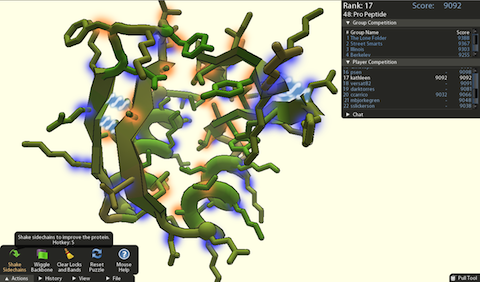 A screengrab of online protein-folding game, Foldit
THE REGISTER has a positive report on an aspect of the effort to develop an effective HIV vaccine. According to Anna Leach's article, "Online gamers strike major blow in battle against AIDS", non-science types have been of great assistance in the development of proteonomic science, the science of protein chemistry, which is the next great medical revolution. If proteonomics were compared to the history of flight, currently, we are at WW1-era level of competence.
Why should you care? Well, besides the warm, fuzzy idea of an HIV vaccine, those of you under thirty will live long enough to see proteonomics really take hold as therapy, with the benefit of treatment without the ghastly side-effects of pill-medicine. Needless to say, Big Pharma are concerned — especially when a bunch of gamers can provide the key to solving sumbitch-difficult analysis.
A bunch of gamers have untangled the structure of a key protein in the virus that causes AIDS, a mystery that has left scientists stumped for decades.
It took just three weeks for players of online game Foldit to predict an accurate model for the protein – a type of enzyme called a retroviral protease that has a critical role in how the HI virus grows and spreads.
The game Foldit was specially designed to help work out the structure of proteins. It combines computer intelligence with human spatial abilities by asking players to tweak and tug 3D models, a task that computers find hard to do.
The gamers – most of whom have no background in biochemistry – generated models good enough for the researchers to refine and, within a few days, determine the enzyme's structure. In the research published yesterday in Nature Structural & Molecular Biology, lead authors biochemists Firas Khatib and Frank DiMaio gave gamers equal billing with the rest of their biochemist co-authors.
Maybe there's an alternative to Angry Birds?
 HIV
HIV
MEDICAL XPRESS has a disturbing report: "First large study to find HIV epidemic among gays in the Middle East". HIV epidemics are emerging in several countries in the Middle East and North Africa among men who have sex with men, a term that encompasses gay, non-gay identified homosexual men, and transgendered and bisexual men.
"The Middle East and North Africa can no longer be seen as a region immune to the HIV epidemic. Based on multiyear analysis of thousands of data sources, we documented a pattern of new HIV epidemics that have just emerged among men who have sex with men in the last few years in several countries of the region," said Ghina Mumtaz, main author of this study and senior epidemiologist in the infectious disease epidemiology group at Weill Cornell Medical College-Qatar.
The study reports that rates of HIV infection among men who have sex with men vary across the region but have already exceeded 5 percent, the threshold defining concentrated epidemics, in several countries such as Egypt, Sudan and Tunisia. In one area of Pakistan, the infection rate among men who have sex with men has already reached 28 percent. Moreover, by 2008, transmission of HIV via anal sex among men was responsible for more than a quarter of reported cases of HIV in several countries in the region.
28% infection rate? Yikes! There has got to be severe social stress, considering the social milieu.
 NAM AIDSMAP is a site that proclaims its goal to be: "NAM works to change lives by sharing information about HIV and AIDS. We believe independent, clear and accurate information is vital in the fight against HIV and AIDS"
Anyway, they have a report that seems too good to be true: in Germany, a patient has been cured of HIV through stem-cell transplants. Check it out.
 This image shows the atomic structure of the antibody VRC01 (blue and green) binding to HIV (grey and red). The precise site of VRC01-HIV binding (red) is a subset of the area of viral attachment to the primary immune cells HIV infects. (Credit: NIAID VRC)
Scientists have discovered two potent human antibodies that can stop more than 90 percent of known global HIV strains from infecting human cells in the laboratory, and have demonstrated how one of these disease-fighting proteins accomplishes this feat. According to the scientists, these antibodies could be used to design improved HIV vaccines, or could be further developed to prevent or treat HIV infection.
• • • • •
Led by a team from the NIAID Vaccine Research Center (VRC), the scientists found two naturally occurring, powerful antibodies called VRC01 and VRC02 in an HIV-infected individual's blood.
• • • • •
The researchers also determined the atomic-level structure of VRC01 when it is attaching to HIV. This has enabled the team to define how the antibody works and to precisely locate where it attaches to the virus. With this knowledge, they have begun to design components of a candidate vaccine that could teach the human immune system to make antibodies similar to VRC01 that might prevent infection by the vast majority of HIV strains worldwide.
Well, they just may have found the chink in the HIV armour:
With the support of the National Institutes of Health, the Arnolds and their team have been able to take a piece of HIV that is involved with helping the virus enter cells, put it on the surface of a common cold virus, and then immunize animals with it. They found that the animals made antibodies that can stop an unusually diverse set of HIV isolates or varieties.
The approach taken by the Arnolds and their colleagues has been to identify a part of the AIDS virus that is crucial to its viability – something the virus needs in order to complete its life cycle – and then target this Achilles heel.
 Human rhinovirus showing pieces of HIV (red) that stimulate helpful immune responses displayed on the rhinovirus surface, thereby creating a safe mimic of HIV. (Credit: Gail Ferstandig Arnold)

HIV-infected T cells. (Credit: Courtesy of Dr. Tom Folks, NIAID)

